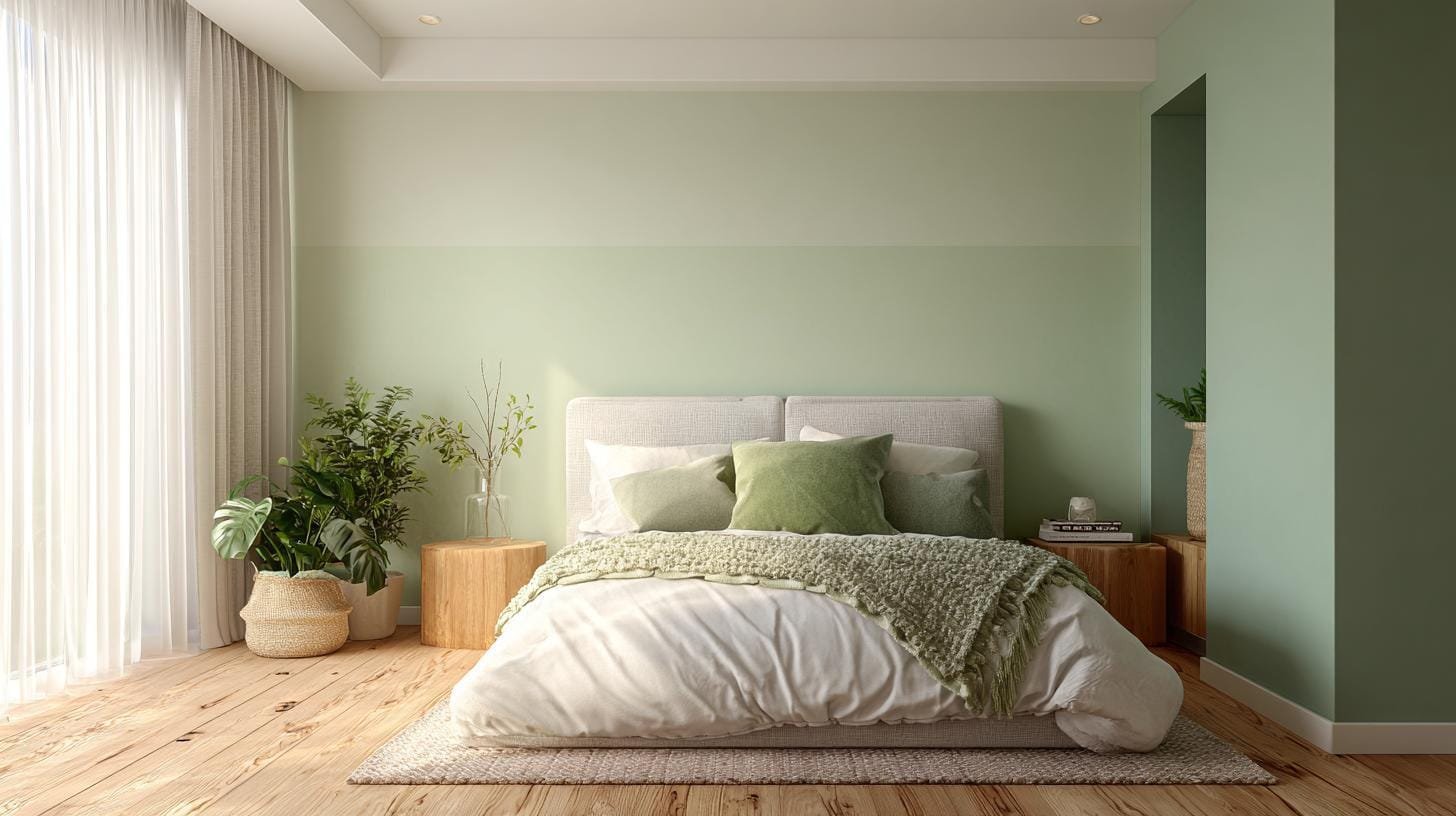
Bedroom design for better sleep, light, sound and layout
Design a bedroom around darkness, quiet, temperature and clearances, with bed sizes and wardrobe depths that make the room work at 3am and at 8am.
A bedroom has one job that matters more than the others, and most bedrooms are decorated as though it were a sitting room with a bed in it. Sleep responds to darkness, quiet, temperature and the absence of clutter. This guide works through each of those as a design decision, with the bed clearances, wardrobe depths and lighting choices that make the room function both at night and on a rushed weekday morning.
Get the darkness right
Light is the strongest external cue for the human sleep-wake cycle, and bedrooms usually leak it from four places: the window, the door, standby LEDs and the street.
The window
Blackout is a fitting problem, not a fabric problem. Most so-called blackout curtains fail because light comes around the edges rather than through the cloth.
- Track or pole position. Mount well above the window head, ideally 150–300mm (6–12"), or run the track to the ceiling. This kills the light gap at the top, which is the brightest one.
- Width. Curtains should extend 150–250mm (6–10") past the reveal on each side, so the fabric overlaps the wall rather than stopping at the frame.
- Return. A track with returns that bend back to the wall, or a pole with a wraparound bracket, removes the side gap entirely.
- Length. Full length to the floor performs better than sill length for both light and draughts.
- Blinds. A roller blind inside the reveal will always leak at the sides. A blackout blind fitted outside the reveal, or a cassette-and-side-channel system, actually works. In rentals, a temporary blackout blind fixed to the frame with removable adhesive is a reasonable compromise, as covered in rental-friendly upgrades you can undo.
The best-performing combination is a blind for total darkness plus curtains for softness, insulation and acoustics.
Everything else that glows
Standby lights on televisions, chargers, air purifiers and smoke alarms add up. Cover them with a small piece of opaque tape, except anything that indicates a safety function. Never obstruct a smoke alarm.
:::tip Test your blackout at night with the room lights off and a torch outside the window, or simply sit in the dark for five minutes and let your eyes adjust. Every leak becomes obvious. Fix the top edge first, then the sides. :::
Manage the sound
Sound is harder to fix than light, but the interventions follow a clear hierarchy.
Stop the air paths
Sound travels through gaps far more effectively than through solid material. Before doing anything expensive:
- Fit a draught seal around the door frame and a brush or drop seal at the threshold. This is the highest-value acoustic fix in most bedrooms and it costs very little.
- Replace a hollow-core internal door with a solid-core one if noise from the rest of the house is the problem. Mass is what blocks sound.
- Seal gaps around pipes, sockets and any service penetrations in a party wall.
Add mass and absorption
Mass blocks sound coming through a structure. Absorption reduces the reverberation inside the room, which makes the room feel quieter even when the external noise is unchanged.
- Heavy interlined curtains help with both, particularly against traffic noise through single glazing.
- A wool rug or carpet on a hard floor cuts both impact noise and echo.
- Upholstered headboards and soft wall hangings absorb mid and high frequencies.
- Bookshelves full of books on a shared wall are genuinely useful as diffusers and add mass.
Be realistic. These measures soften a noise problem; they do not eliminate a neighbour's subwoofer. Serious sound insulation means independent stud walls, resilient bars and acoustic quilt, which is structural work belonging in the sequence set out in renovation order of work.
Temperature and air
Most people sleep better in a cool room than a warm one. That means a bedroom needs to lose heat at night and gain it in the morning, which is the opposite of how many are set up.
- Put the bedroom heating on a separate zone or a thermostatic radiator valve so you can run it cooler than the rest of the house.
- Ventilate. A trickle vent or a briefly opened window before bed drops both temperature and CO2. A closed, unventilated bedroom with two occupants gets stuffy quickly.
- In summer, close curtains and blinds during the day on sun-facing windows. Blocking the heat before it enters is far more effective than cooling the room later.
- Choose breathable bedding. Linen and cotton manage moisture better than polyester blends, which matters more than thread count.
- Avoid siting the bed directly under a single-glazed window or against a cold uninsulated external wall. Both create a cold radiant surface next to your head.
Layout and clearances
The bed is the largest object in most homes, and it dictates everything else.
| Bed size | Typical mattress dimensions | Notes |
|---|---|---|
| Single | 900 x 1900mm (3'0" x 6'3") | Fits a small room; check length for tall teenagers |
| Small double | 1200 x 1900mm (4'0" x 6'3") | A compromise for two adults |
| Double | 1350 x 1900mm (4'6" x 6'3") | The common UK standard |
| King | 1500 x 2000mm (5'0" x 6'6") | Needs a room of roughly 3 x 3.4m (10' x 11') to work |
| Super king | 1800 x 2000mm (6'0" x 6'6") | Needs a genuinely large room |
Sizes vary by market, so measure the actual product rather than trusting the label.
The clearances that matter
- Both sides of a shared bed: 600mm (24") minimum, 750mm (30") comfortable. Anything less and one person climbs over the other.
- Foot of the bed to wall or wardrobe: 700–900mm (28–36"), and at the upper end if wardrobe doors open into that space.
- Wardrobe door swing: a hinged door needs its own width in clear floor. Sliding doors need none, but you lose access to half the opening at a time and typically 80–100mm (3–4") of internal depth to the track.
- Bedside table height: within about 50–100mm (2–4") of the mattress top, so you can reach a glass without looking.
- Wardrobe internal depth: 600mm (24"), as set out in small-space storage without the gimmicks.
Placing the bed
Put the headboard against a solid internal wall where possible, facing the door but not directly in line with it. Avoid placing the bed so that the door swing opens over it, and avoid a position where you must pass the foot of the bed to reach both bedside tables.
In a very small room, pushing a double against one wall frees usable floor, but it makes bed-making unpleasant and only really suits a single sleeper or a child's room.
:::warning If you are considering a fitted wardrobe across a wall, check where the radiator, the window reveal and any boxing for a soil stack sit before ordering. Fitted joinery cannot be adjusted after manufacture and these obstructions are the most common cause of an expensive remake. :::
Light, colour and surfaces
Lighting
Bedroom lighting should be warm and low, and it must be controllable from bed. Practical specification:
- 2700K or warmer, on a dimmer where possible.
- Individual reading lights, wall-mounted on adjustable arms, so one person can read while the other sleeps. Position the light source beside and slightly behind the shoulder.
- A very low-level night light for the route to the bathroom. A plug-in amber light near the floor is enough, and it avoids the jolt of a ceiling light at 3am.
- Two-way switching so the main light can be turned off from the bed. If rewiring is not possible, a smart bulb with a bedside remote does the same job.
The general approach is expanded in the layered lighting plan.
Colour and texture
Muted, mid-depth colours suit bedrooms better than brilliant white, which can feel stark and reflects morning light straight onto the pillow. Deeper colours make a bedroom feel enclosed and calm, and because you mostly occupy it in low light, the argument that dark walls need daylight matters less here.
Layer soft textures for both comfort and acoustics, then add one hard element so the room does not feel muffled. That balance is discussed in how to mix textures and patterns.
:::budget Ranked by improvement per unit of spend, the bedroom order is usually: mattress, then blackout, then a door seal, then lighting, then everything else. A good mattress on a plain frame beats an impressive bed frame with a tired mattress every night of the year. :::
Keeping the room calm
- No visible work. A desk in a bedroom becomes a stack of paperwork you look at from the pillow. If it is unavoidable, put it in a cupboard with doors you can close.
- Charge phones outside the room, or across the room, on a low warm light.
- Enough closed storage that surfaces stay clear. Two clear surfaces, the bedside tables, is the target.
- Laundry needs a home with a lid. An open basket is visual noise.
- Keep the floor clear. Nothing makes a bedroom feel more restful, and nothing is more often ignored.
The short version
- Fix light leaks at the top and sides of the window first; the fabric is rarely the problem.
- Seal the door with a draught strip and consider a solid-core leaf. It is the cheapest acoustic gain available.
- Run the bedroom cooler than the rest of the house and ventilate before bed.
- Hold 600–750mm (24–30") each side of a shared bed and 700–900mm (28–36") at the foot.
- Use 2700K or warmer light, individual reading lights, and switching you can reach from bed.
- Spend in this order: mattress, blackout, door seal, lighting, then decoration.
Written by
The HDI Editorial Desk
Editorial team
Research, drawings and fact-checking for every guide on Home Designing Idea.
Get the next one by email
One considered piece every other Thursday. No affiliate links.
Keep reading
10 Ways to Update your Homes Interior Lighting to Match Your Own Style
Sometime the biggest changes to your home are the simplest. If you recently purchased a new home or looking to move soon, updating the lighting can instantly elevate the look of any room. Adding a…

5 Home Office Ideas to Boost Your Productivity
For those who have the opportunity to work from home, or for those who know how it is to work from home, we know that it can be difficult sometimes. There are always some type of outside of work…
Living room layout dimensions that actually work
Set out your living room with real clearances, walkway widths and seating distances so the furniture fits the room instead of fighting it.
Be the first to comment
Loading the thread…