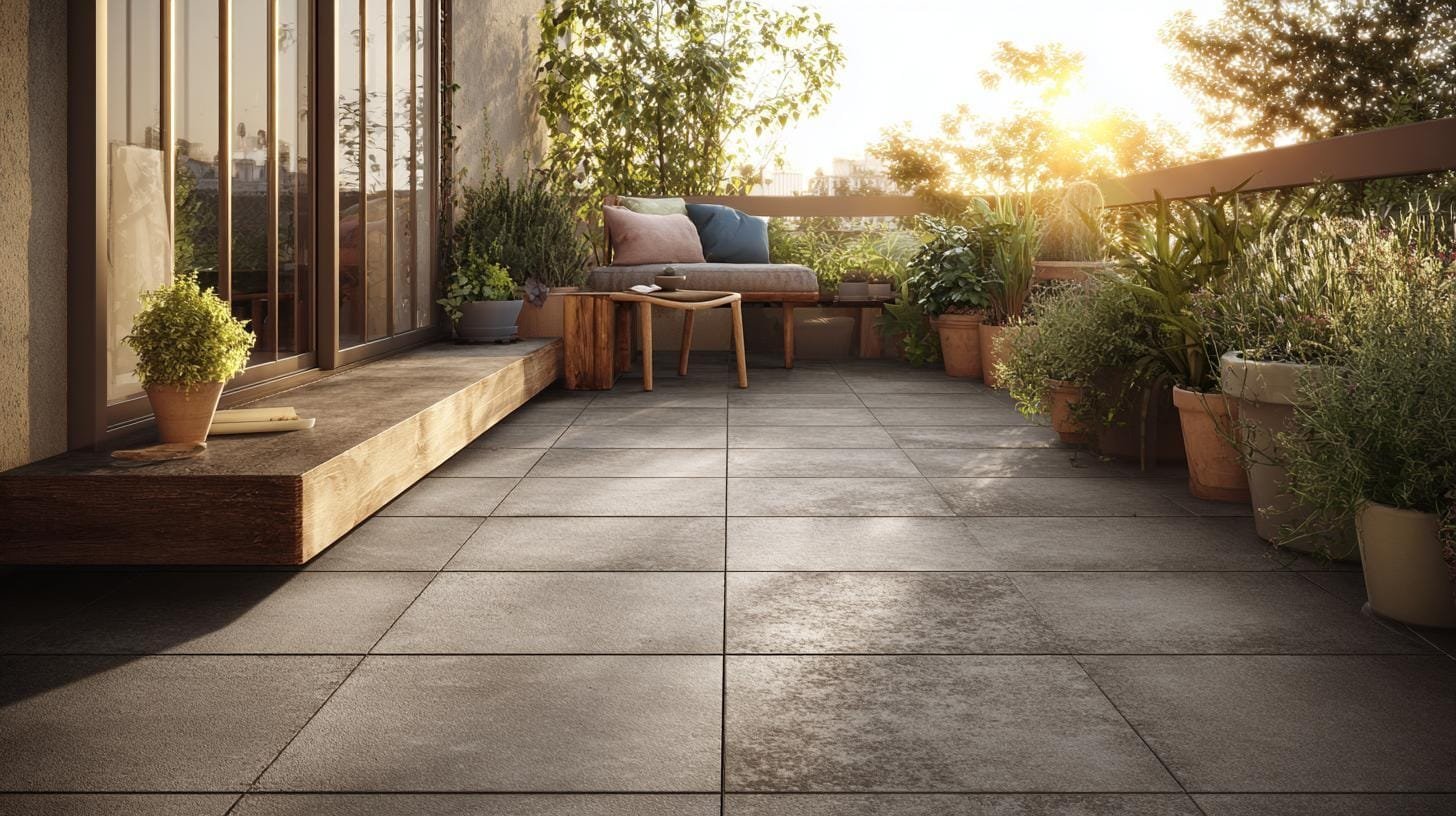
Small balcony planning for seating, shade and drainage
Turn a narrow balcony or courtyard into a usable room with real furniture dimensions, weight limits, drainage checks and planting that survives.
A balcony under about 4 square metres is a room, and it deserves the same planning as an interior one. Most are wasted because a sofa-sized notion gets forced into a corridor-sized space, or because nobody checked what happens to the water. This guide covers the dimensions that make small outdoor spaces work, the structural and drainage questions to answer before you buy anything, and planting that survives real exposure.
Answer the boring questions first
Load
Balconies are structural elements with a design load. Planters full of wet soil are heavy: a cubic metre of moist compost weighs a substantial amount, and large ceramic pots add more before you fill them. Water features, stone paving and raised timber decks all add permanent load.
Practical guidance:
- Keep heavy items over the structural edges, close to the building wall or over the supporting beams, rather than concentrated in the middle of the span.
- Prefer many small light containers over a few enormous ones.
- Choose lightweight growing media, fibreglass or metal planters rather than solid stone, and avoid permanent water features.
- If you are considering anything genuinely heavy, a raised deck, a hot tub, a wall of masonry planters, get advice from a structural engineer. This is not an area for optimism.
Permission and rules
In flats, the balcony is usually part of the building's common structure even when you have exclusive use. Before fixing anything:
- Check the lease or the building rules for restrictions on screens, awnings, decking, drilling and hanging items on the railing.
- Confirm whether items may be hung on the outside face of a balustrade. Many buildings prohibit this outright because of the risk to people below.
- Check any fire safety restrictions on the storage of combustible materials, barbecues and heaters on balconies. Rules on this have tightened in many places, and they exist for good reason.
:::warning Never fix anything to the outside of a balustrade, and never place loose objects where they could be blown over the edge. Wind loads at height are far higher than at ground level, and a light chair on the eleventh floor is a projectile. :::
Drainage and surfaces
Look for the drainage outlet and work out which way the floor falls. Balconies are laid with a fall, usually towards a channel or an outlet, and anything you place on the floor must not dam that route.
- Interlocking deck tiles must sit on a system that allows water beneath and lets you lift them for cleaning. Debris under tiles blocks outlets and holds moisture against the waterproof layer.
- Outdoor rugs should be a permeable, quick-drying type. A rubber-backed rug traps water and will stain the surface underneath.
- Keep the outlet accessible and clear it seasonally. A blocked balcony drain in heavy rain sends water into the flat.
- On courtyards at ground level, check that the finished surface stays well below the damp-proof course of the building and falls away from the wall.
Sizing the space
Outdoor furniture is bulkier than its indoor equivalent, and small-space clearances still apply.
| Element | Working dimension | Note |
|---|---|---|
| Balcony depth for a usable seat | 1.4m (4'7") minimum | Below this you can only line the wall |
| Comfortable two-seat balcony depth | 1.8–2m (6–6'6") | Allows a table with chairs both sides |
| Bistro table diameter | 600–700mm (24–28") | Serves two with drinks and small plates |
| Dining space per seated person | 600mm (24") of table edge | Same as indoors |
| Chair pull-out space | 750mm (30") behind the table edge | Less and you cannot stand up cleanly |
| Circulation past seated person | 600mm (24") minimum | Squeeze width, acceptable outdoors |
| Bench seat depth | 450–500mm (18–20") | 400mm (16") if using loose back cushions |
| Rail-hung planter projection | 200–250mm (8–10") | Keep clear of the walkway |
For a very narrow balcony, under about 1.4m (4'7") deep, stop trying to make it a dining space. Fit a slim bar shelf along the railing at roughly 900–1000mm (36–39") high with two stools, and treat it as a standing or perching spot. It will get far more use than a cramped table.
:::tip Set the whole layout out in chalk or tape, sit in it with a real chair, and open the balcony door fully. Door swing is the constraint people forget, and an outward-opening door can eliminate an entire corner of a small balcony. :::
Furniture that suits the conditions
- Folding and stacking is not a compromise on a small balcony, it is the whole point. Being able to clear the floor turns a two-seat balcony into a yoga mat or a drying space.
- Materials. Powder-coated aluminium is light, rust-resistant and easy to move. Teak and other durable hardwoods weather to grey and last, but they are heavy and should come from a responsibly certified source. Untreated softwood on an exposed balcony will not last. Plastic rattan varies enormously in UV stability and the cheap version becomes brittle.
- Cushions. Buy outdoor-grade fabric and a storage box you can actually reach. Cushions left out through rain never dry properly and go mouldy.
- Storage bench. The one piece of dual-purpose furniture worth it outdoors, because it solves both seating and the cushion problem in the same footprint. That is a rare exception to the scepticism in small-space storage without the gimmicks.
Shade, shelter and privacy
Sun
Work out where the sun actually is. A west-facing balcony is unusable at 17:00 in summer without shade, and a north-facing one may never need it. Options in ascending order of permanence:
- A large parasol with a weighted base. Simplest, but the base is heavy and the parasol must come down in wind.
- A clamp-on side awning or a retractable vertical screen. Blocks low sun, which a parasol cannot.
- Shade sails. Effective if you have three solid fixing points, which most balconies do not. Requires permission and proper fixings.
- A fixed awning. Best result, biggest cost, almost always needs building consent.
Wind
Wind is a bigger limitation than sun on most balconies above the second floor. It knocks over plants, tears leaves and makes the space unusable. A permeable screen, a slatted panel or a run of tough planting slows wind more effectively than a solid panel, because a solid barrier creates turbulence behind it.
Privacy
Reed or willow screening zip-tied to the inside of a railing is the cheap solution and looks better than plastic mesh. Slatted timber panels fixed to the floor inside the railing are the better-looking version. Planting is the most pleasant screen of all, and it does the wind job at the same time.
Planting that survives
Balcony conditions are harsh: wind, reflected heat off glass and masonry, a limited root volume, and pots that dry out in hours in summer.
Choose by exposure, not by looks
- Hot, dry, sunny. Mediterranean and drought-tolerant plants: rosemary, thyme, lavender, sedum, olive in a large enough pot, ornamental grasses.
- Shady and sheltered. Ferns, hostas if slugs are not a problem, ivy, heuchera, hardy geraniums.
- Windy. Small-leaved and flexible plants: grasses, pine, box, hebe. Large soft leaves shred.
- Edible. Herbs are the highest reward per pot. Salad leaves, chillies and dwarf tomatoes work in sun with reliable watering.
Container fundamentals
- Bigger pots dry out more slowly. A cluster of tiny pots is the most demanding possible arrangement in summer.
- Drainage holes are non-negotiable, and pots need feet or a gap so water can leave without pooling on the balcony surface.
- Use a peat-free potting compost, not garden soil, which compacts in containers.
- Feed through the growing season. Container plants exhaust the nutrients in their compost within a couple of months.
- Group plants with the same watering needs together so one routine serves them all.
Go vertical to save floor area: a wall-mounted trellis with climbers, tiered shelving against the building wall, or rail planters on the inside face of the balustrade.
:::budget Two or three large, good containers with well-chosen plants will look considerably better than a dozen small mismatched pots, and they will survive a hot week when you are away. Buy fewer, bigger, and spend the saving on a decent watering system if the balcony is exposed. :::
Lighting and the evening
An outdoor space only doubles your living area if it works after dark. Keep it warm and low.
- Solar string lights along the railing or overhead, at 2200–2700K rather than cold white.
- One or two rechargeable portable lamps on the table, which need no fixed wiring at all.
- Uplight one plant from below. It creates depth on a small balcony better than anything else.
- Avoid a single bright wall-mounted floodlight. It flattens the space and annoys the neighbours.
Any fixed outdoor electrical work must use suitably rated fittings and protection, and should be installed by a qualified electrician. The layering logic is the same as indoors and is set out in the layered lighting plan.
The short version
- Check load, lease restrictions, fire rules and the drainage fall before buying anything.
- A balcony needs about 1.4m (4'7") of depth for real seating; under that, fit a rail bar and stools.
- Choose folding, stacking, lightweight furniture and one storage bench for cushions.
- Slow the wind with permeable screening rather than blocking it with a solid panel.
- Fewer, larger containers with exposure-appropriate planting survive far better than many small pots.
- Light it low and warm with solar or rechargeable fittings, and uplight one plant for depth.
Written by
The HDI Editorial Desk
Editorial team
Research, drawings and fact-checking for every guide on Home Designing Idea.
Get the next one by email
One considered piece every other Thursday. No affiliate links.
Keep reading
The small mistakes that make a room look cheap
The specific proportion, finish and detailing errors that undermine a room, and the low-cost corrections that make it read as considered instead.
Small-space storage that works without the gimmicks
Real storage for small homes, built on measured volumes and standard depths rather than novelty furniture that stores almost nothing.

What is the difference between a studio roof and a gable roof?
When you’re looking at installing a new sunroom, it can be easy to get caught up in the big picture, planning out what to do with all the extra space and how you’ll entertain throughout the year with…
Be the first to comment
Loading the thread…